Lifecycle event hooks
Learn how to setup and use Lifecycle Event Hooks to integrate your customer-facing applications with any other homegrown systems or third-party products that you may own, such as CRM or Marketing Hubs
Strivacity Lifecycle Event Hooks (LEH) provide a method to integrate your customer-facing applications with homegrown systems and third-party products.
Lifecycle Event Hooks can be used in many different ways. Some of the more common use cases involve customizing registration, updating or fetching data from remote systems such as CRMs during certain lifecycle events, or alerting third-party systems on specific events of interest, such as:
- Deep customization of registration: Brands often require extensive customization of the registration process. Information from external systems, such as CRMs, may be required to keep multiple disparate databases in sync. Often, a brand will pull this in during a pre-registration hook to allow it to be submitted during the registration process. New or additional information can be easily synchronized back to an external system in real-time.
- Customer data synchronization: Brands may require keeping disparate customer databases in sync, such as the customer identity store and a remote CRM system. Customer Lifecycle Event Hooks can be used to dispatch information about events of interest to these remote systems.
- Alerting: Brands may desire to be alerted when an event of interest occurs, such as a password reset request.
- Consume and use threat information: Insert threat detection and mitigation into any point in the customer lifecycle, giving security teams highly contextual alerting when threats are detected. Existing threat information can be used to make risk analysis decisions.
An actual Lifecycle Event Hook is a brand-provided snippet of JavaScript code that executes at predefined points in a customer's lifecycle, such as registration, login, consent opt-in or out, or account deletion. A full listing of events and how they can be used is provided below. All snippet code executes within the context of the Strivacity platform in a safe and secure sandboxed environment. Two modes are supported:
- Synchronous: Control is transferred to the script for execution. Upon completion, control is returned to Strivacity's normal workflow execution.
- Asynchronous: The script is executed but control is not transferred, and Strivacity continues on with its normal workflow execution.
Plugin library
Plugins make publishing lifecycle event hooks easy.
The plugin library provides you with hook templates for common use cases. Event hook templates are off-the-shelf integration and advanced capability packages that you can customize for your own needs and add to your applications.
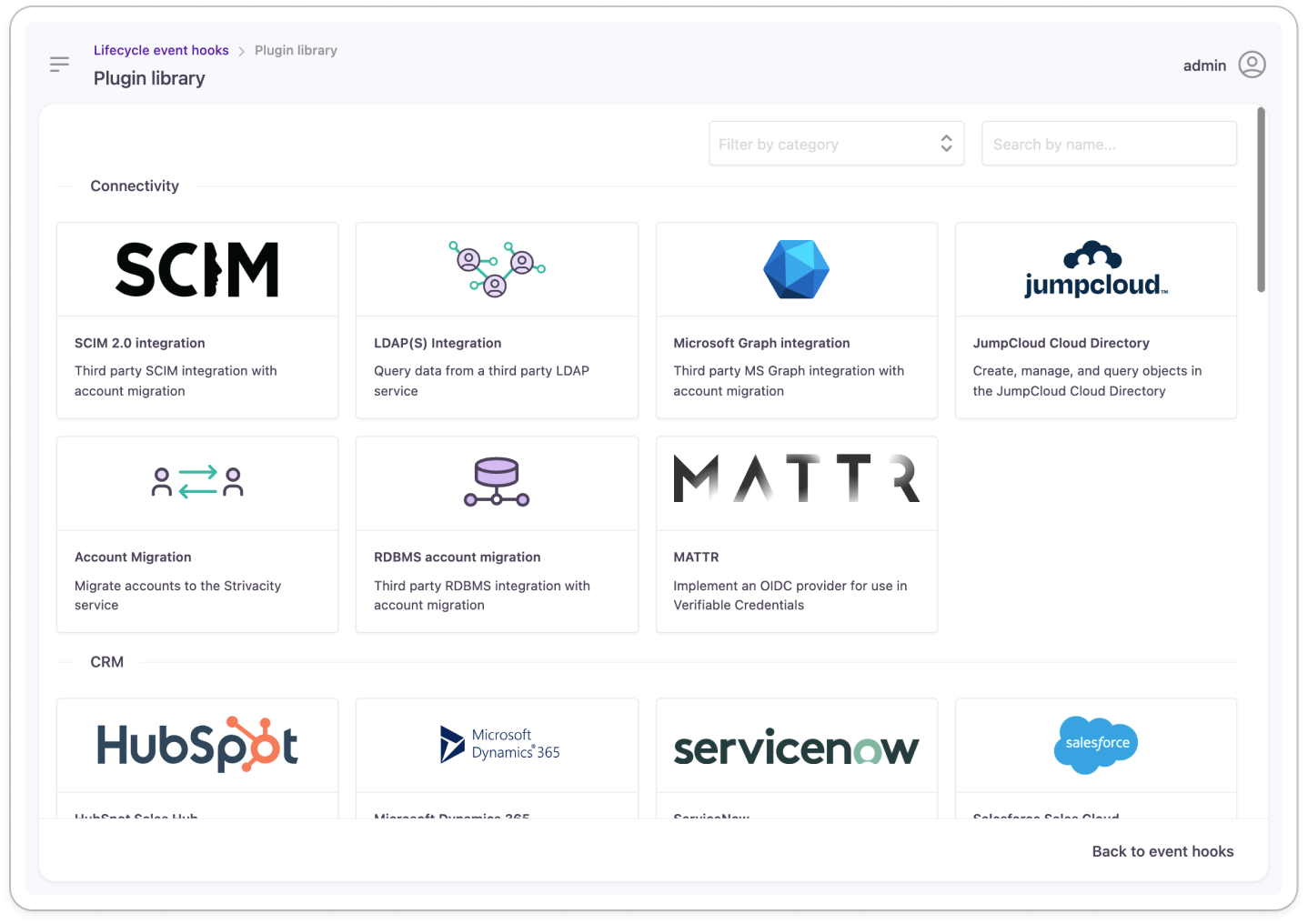
Plugin library preview
The template packages come with all the necessary dependencies set up. Their point-of-entry into the customer lifecycle is also configured, so you don’t have to think about selecting the right event hook type:
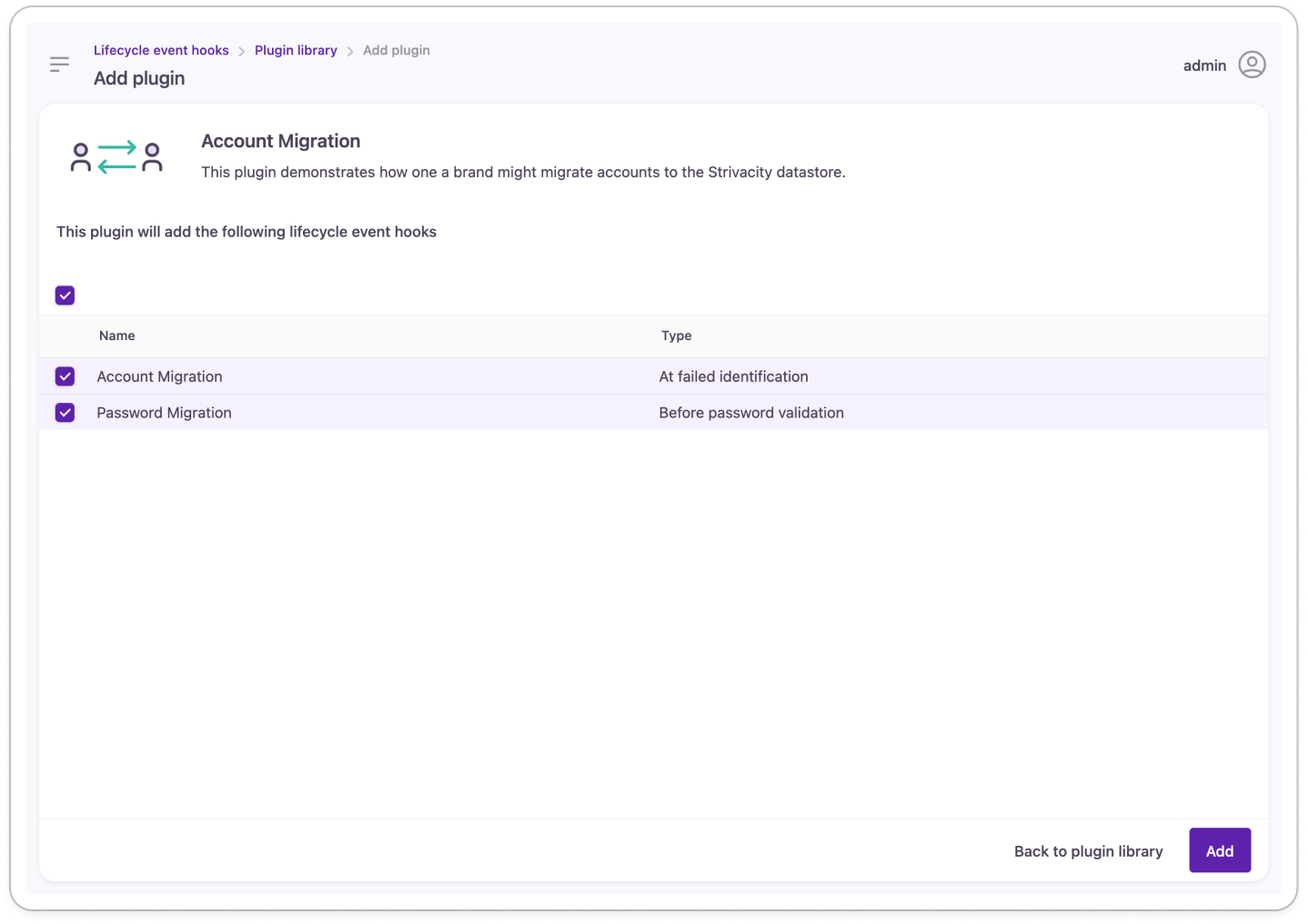
Lifecycle event hook templates for account migration
After selecting the capability that you want to add to your application, you can publish the template as a new lifecycle event hook. You can customize the code inside the hook and assign it to an application to have it deployed.
Supported events
Multi-stage progressive profiling
Strivacity’s "Before registration" and "Before progressive profiling" event hooks allow you to introduce progressive profiling steps to customer journeys on your conditions. You can configure steps to adapt to your customers' activity to make data collection a more personalized experience.
The following table shows a summary of the events that are supported by Strivacity with examples of how they can be used:
At failed...
After...
Before...
Where and when hooks are launched
Lifecycle Event Hooks are launched at various places in the customer journey. To understand where and when event hooks are fired, refer to our customer workflow diagrams
How it works
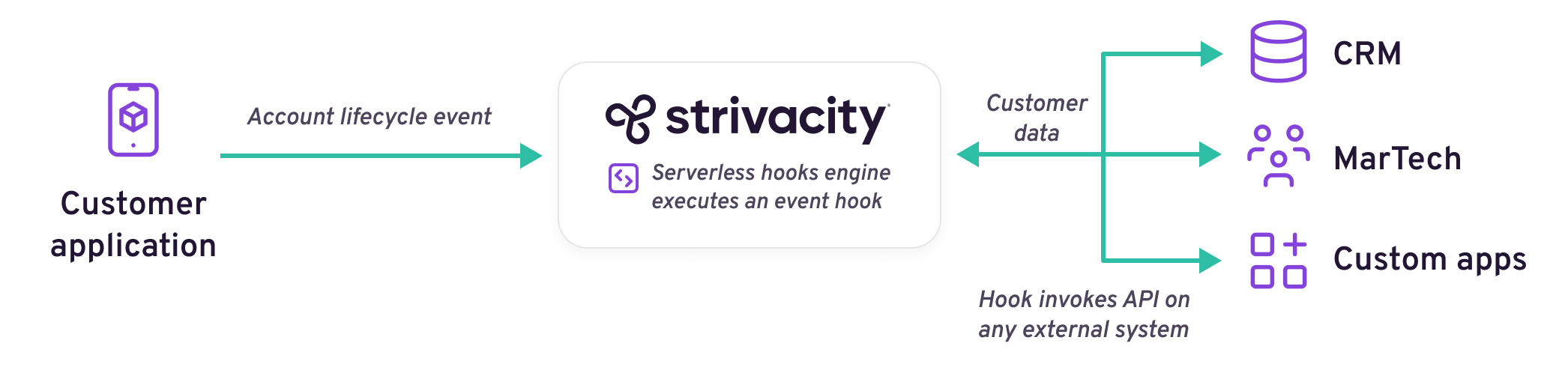
Example use cases
- Customize registration by bringing in and persisting external data.
- Establish a single source of truth and synchronize customer data across multiple systems.
- Insert threat detection and response into any point in the customer lifecycle.
- Alert your customer service or security teams to events of interest.
- Trigger workflow in external orchestration systems when customers perform specific actions.
- Make location-based decisions in customer login and registration flows.
Updated 25 days ago